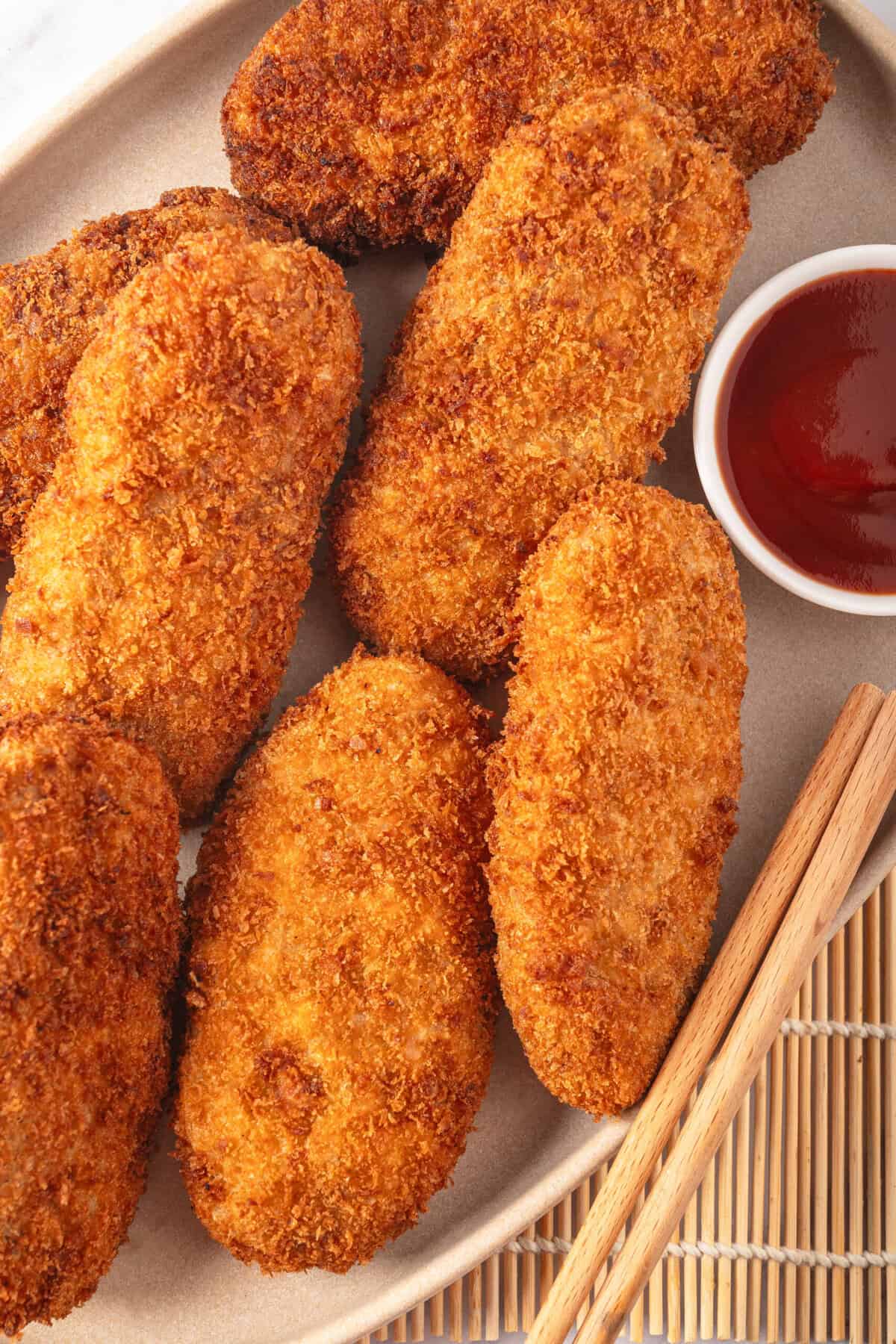


Meet Korokke: the Japanese croquette that will steal your heart.
Table of Contents
What’s the difference between a korokke and a croquette?How do I store leftovers?Serving suggestionsKorokke Recipe
I absolutely love korokke. Growing up in a Japanese-American household meant being surrounded by incredible food, but korokke was always my number one favorite as a kid. Whenever we visited my grandmother in Tokyo, she would prepare countless batches of korokke with an amazing variety of fillings. She’d make vegetable and curry versions, octopus with shiso leaf, and ground pork mixed with miso paste. Those memories of her kitchen filled with the sound of sizzling oil and the aroma of golden-brown korokke remain some of my most treasured memories from childhood.
Living in Italy now, it’s pretty hard to find decent Japanese food. While we do have fried rice balls here called arancini, it’s just not the same as korokke. Last week, my korokke craving hit hard, and thankfully, this recipe came to save the day! The perfect trio of crunchy panko breadcrumbs, rustic mashed potatoes, and that signature tonkatsu sauce creates something that simply can’t be replicated by croquettes or arancini. The moment I took that first bite, I was instantly transported back to my grandmother’s kitchen in Tokyo. Making these at home has become my way of bringing a piece of Japan to my Italian kitchen, and now I can satisfy those intense cravings whenever they strike.
What’s the difference between a korokke and a croquette?
Korokke is simply the Japanese version of the French croquette. The korokke has been adapted to the Japanese palate and ingredients. While traditional French croquettes often feature a creamy béchamel base with ingredients like ham or cheese, Japanese korokke typically uses mashed potatoes as the foundation, like in this recipe. The most popular variety in Japan is potato korokke, though you’ll also find versions with crab, curry, cheese, or vegetables. Both are breaded and deep-fried to golden perfection, but korokke tends to have a more substantial, chunky texture compared to the smoother French style. The main difference lies in the base ingredients and cultural preferences rather than the cooking technique itself.
How do I store leftovers?
If you have any leftover korokke, you can store them in an airtight container in the refrigerator for up to 2 days. The best way to reheat the korokke is in a 375°F oven on a wire rack for 8-12 minutes. The wired rack is crucial if you want to restore that crispy crust. An air fryer at 350°F for 3-5 minutes works even better if you have one available. Avoid using the microwave as it will make the panko breadcrumbs soggy and ruin the texture.
Serving suggestions
While these korokke are absolutely delicious on their own, they’re even better when they are served with a few side dishes. Whenever my grandma would make korokke for my siblings and me, she would serve it with a side of fluffy Sushi Rice topped with an umeboshi plum, Pickled Daikon, Cucumber Kimchi, and Miso Soup. When I prepare korokke, I embrace the deep-frying technique and usually prepare some Shrimp Tempura and Chicken Katsu. Garnish with Japanese mayonnaise, chopped scallions, and yuzu kosho to provide a bright contrast to the crispy, fried exterior.
Korokke Recipe
Ingredients
2 pounds russet potatoes, peeled and cut into even chunks
1 tablespoon unsalted butter
1/2 teaspoon salt divided
1/4 teaspoon freshly ground black pepper, divided
2 teaspoons neutral oil, for sautéing
1 medium yellow onion, finely chopped
16 ounces lean ground beef
1/2 cup all-purpose flour
2 eggs, beaten
1 2/3 cups panko breadcrumbs
Oil for deep-frying, enough for 2 inches deep
Tonkatsu sauce, for serving
Instructions
Nutrition
The post Korokke Recipe appeared first on Food Faith Fitness.